

Thank you for visiting our site! You landed on this page because you entered a search term similar to this: simplifying square root expressions calculator, here's the result:
Square Roots
A square root of a number is a number that you can square to get it, that is a number that you can multiply by itself to get the number. So 2 is a square root of 4, because 22=4 and 3 is a square root of 9, because 32=9. (-2)2 is also 4 and (-3)2 is also 9. Numbers that have square roots always have two, a positive one and a negative one. But the square root symbol means only the positive one, so we can have one answer to our problem. Negative numbers don't have square roots, because when you multiply numbers with like signs you get positive numbers.
What about a number like 2 or 5 or 10. Do they have square roots? Are there numbers that you can multiply by themselves to get numbers like these? Clearly there are no whole numbers that will work, but what about something involving fractions? It turns out that fractions won't work either. It turns out that if you can't find a whole number to square and get a given whole number, no fraction will work either. But it also turns out that square roots of all whole numbers do correspond to lengths. This is kind of strange I think, lengths that can't be measured by whole numbers or fractions, but it really is true. To measure such lengths mathematicians use irrational numbers. Read my article Irrational Numbers to learn more about this. You can also find out more about irrational numbers by going on my pi tour.
You can approximate such square roots by rational numbers, and you can get as close as you want, and it is quite easy to do so. The simplest way is to just do a lot of guessing and checking. First find the two whole numbers that it is between and then the nearest 10th, the nearest 100th, etc., etc.. For example if you want to find out what the square root of 2 is, you know that it must be between 1 and 2, because 12=1 and 22=4 and 2 is between 1 and 4. 2 is closer to 1 than to 4, so the square root of 2 must be closer to 1 than to 3, but not that much, so we might guess 1.3 or 1.4. If we guess 1.3 and square it we get 1.32=1.69, which is much too small, so try 1.4. 1.42=1.96, still too small, but 1.52=1.25, which is much too big, so to the nearest 10th the square root of 2 is 1.4. To get another decimal space since 1.42=1.96 is much closer than 1.52=2.25, we might try 1.41. 1.412=1.9881, still too small. 1.422=2.0164, too big. 1.412 is closer, so to the nearest 100th the square root of 2 is 1.41. Continuing like this we should be able to get as close as we want. There are also fancier methods that do it a bit quicker and your calculator uses one of these, and by using a calculator you don't actually have to go through such a long process to find a square root. But it is useful to try it at least once, just to make sure you really know what a square root is. After that you can find an approximation for any square root just by keying the number into the calculator and pushing the square root button.
But since these will only be approximations anyway, most of the time in mathematics we just leave the square root undone and use

One thing that is important to do is to get using to using radical notation.
That funny symbol over the 2 is called a radical. When it is put around
a number the whole thing then means the positive number that can be square
to get that number. That means, for example, that  means the positive number that you can square and get 4, which means that
it is equal to 2. Similarly an expression like
means the positive number that you can square and get 4, which means that
it is equal to 2. Similarly an expression like


Whenever you have an expression with radicals in it and they can be evaluated, all you have to do to simplify the expression is replace the radicals with what they are equal to. So for example if you have

(5)(3)+(2)(5).
Then we do the rest of the arithmetic and get
15+10=25.
On the other hand, the radical symbol creates an automatic grouping. Any operation inside it is done before taking the square root. So in

 .
.
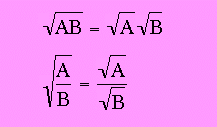

even though you can only approximate the answer to it with a rational number, you can evaluate part of it and make the irrational part smaller, and it is considered to be a simpler way to write it. What you do is you use the first of the properties above to write it as the square root of 4 times the square root of 3, and the important thing here is that the square root of 4 can be evaluated.


The second of these properties is useful for evaluating square roots of fractions, because it allows you to do it by finding the square roots of the numerator and the denominator individually.

It is really important when using these properties to realize that these properties are special to multiplication and division. The reason they work has to do with the fact that powers are repeated multiplication. Powers aren't repeated addition, so there are no similar properties for addition and subtraction. The expression

